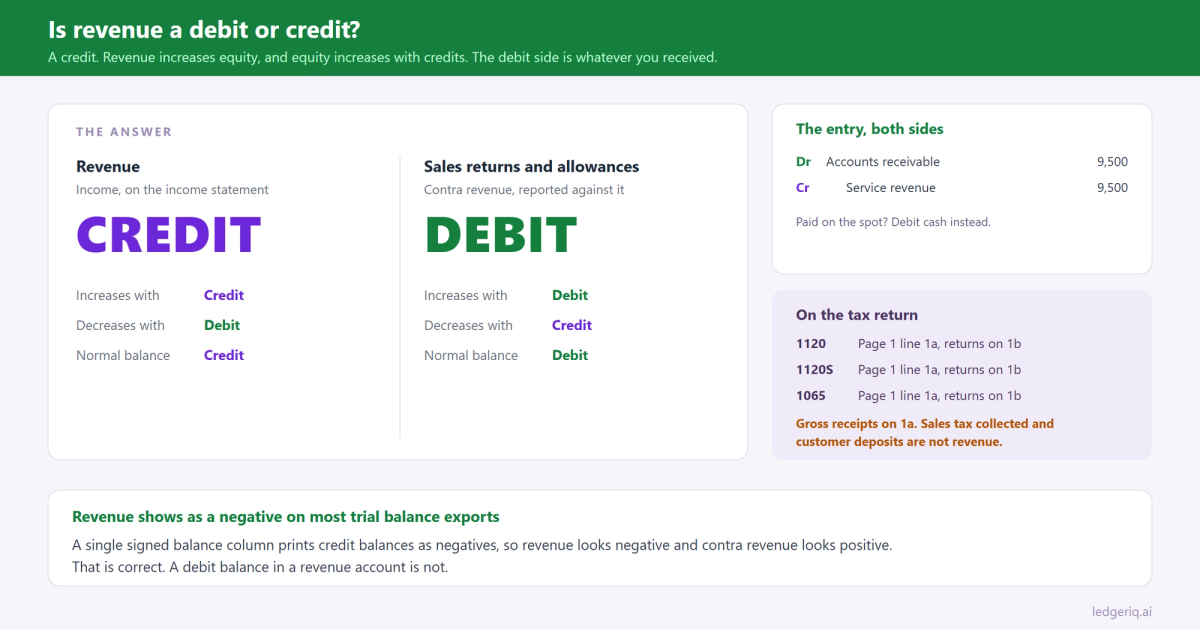
Revenue is a credit. It increases with a credit, decreases with a debit, and carries a normal credit balance. Every sale credits a revenue account, and the debit goes to cash or to accounts receivable depending on whether you were paid.
That is the answer. What follows is the part that decides whether the revenue figure on the return is the right one.
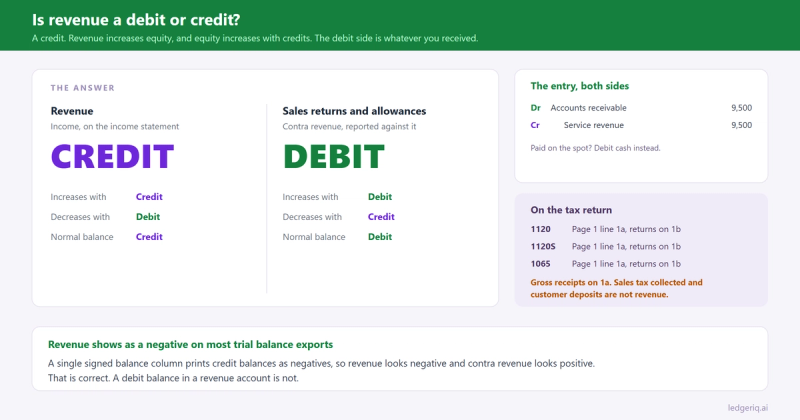
The short answer
Increases with: a credit. Sales, service income, fees and commissions all behave the same way.
Decreases with: a debit. Refunds, credit memos and closing the account at year end.
Normal balance: credit. A revenue account should carry a credit balance, or show as a negative number in a signed balance column, all year.
Why it works that way
Revenue increases equity, and equity increases with credits.
Work through it. The business earns 9,500. Nobody put money in, nothing was borrowed, and the owners are better off by 9,500. That improvement lands in equity, and because equity sits on the right side of the accounting equation, the entry that records it is a credit.
The debit side is whatever you received. Cash if they paid on the spot, accounts receivable if they will pay later. Either way an asset increased, and assets increase with debits.
Revenue accounts are temporary. At the end of the year they close out to retained earnings or to the partners' capital accounts, which is why the balance sheet carries equity rather than a running sales figure. A trial balance dated mid year shows the year to date revenue. A trial balance dated after the books are closed shows zero.
Journal entries, with numbers
A sale on account of 9,500.
- Debit Accounts receivable 9,500
- Credit Service revenue 9,500
A cash sale of 1,200.
- Debit Cash 1,200
- Credit Sales revenue 1,200
A refund of 400 to a customer. Use a contra revenue account rather than debiting sales directly, so the gross figure survives for the return.
- Debit Sales returns and allowances 400
- Credit Cash 400
A customer deposit of 5,000 for work not yet done. This is not revenue. It is a liability until you earn it.
- Debit Cash 5,000
- Credit Unearned revenue 5,000
Earning that deposit when the work is delivered.
- Debit Unearned revenue 5,000
- Credit Service revenue 5,000
A 10,000 sale settled through a payment processor that keeps a 290 fee. Record the gross sale and the fee separately. Netting them understates both revenue and expense.
- Debit Cash 9,710
- Debit Merchant fees expense 290
- Credit Sales revenue 10,000
How it looks on a trial balance export
Separate debit and credit columns. Revenue sits in the credit column. Contra revenue accounts, sales returns and allowances and sales discounts, sit in the debit column, because they run against revenue.
A single signed balance column. Revenue prints as a negative number, often in parentheses. That surprises people the first time, and it is correct: the export is showing a credit balance. Contra revenue prints as a positive.
A debit balance in a revenue account is worth stopping on. It means refunds or credit memos exceeded sales for the period, which happens legitimately in a tiny month and otherwise means something was posted backwards, usually a refund entered as a negative sale against the wrong account.
One more: revenue on the trial balance should agree to the revenue in the client's sales reports and, for a sales tax registered business, broadly to the sales reported on their sales tax filings. When the trial balance says 1,284,000 and the sales tax returns add up to 1,460,000, that gap is a question you want to ask in January rather than have asked of you later.
Where it goes on the tax return
Revenue reaches page 1 of the return, as gross receipts, with returns and allowances shown separately.
- Form 1120: page 1 line 1a gross receipts or sales, line 1b returns and allowances
- Form 1120S: page 1 line 1a, with 1b for returns and allowances
- Form 1065: page 1 line 1a, with 1b for returns and allowances
Three things decide whether that figure is right.
Gross, not net. The form asks for gross receipts on 1a and takes returns and allowances out on 1b. A client who records sales net of refunds reports a smaller gross receipts figure than their own records support. On an 1120 it also interacts with the 500,000 total receipts test that decides whether Form 1125-E is required.
Not all income is gross receipts. On an 1120, interest, rents, royalties, dividends and capital gains each have their own line on page 1. On an 1120S and a 1065, items like interest and rental income are separately stated and flow through Schedule K rather than sitting in ordinary business income. A trial balance with one Other Income account containing all of it has to be split before it maps.
Sales tax collected is not revenue. It is a liability owed to the state. A client who records gross deposits as sales overstates revenue by the tax and understates the liability by the same amount.
Mistakes that throw it off
Recording the customer payment as revenue when the invoice already did. Revenue is counted twice and accounts receivable never clears. This is the single most common revenue error in small business books, and the receivable balance that only ever grows is the symptom.
Recording deposits as income. Money received before the work is done is unearned revenue, a liability. On an accrual basis return it belongs there, and treating it as revenue accelerates income into the wrong year.
Netting merchant fees, commissions or refunds. Each one understates revenue and the matching expense. The return then shows a gross receipts figure that does not agree with the processor statements or the sales tax filings.
Journal entries straight to revenue at year end. A plug to make the books agree with something, posted to sales, changes the top line of the return. If an adjustment is needed, it belongs in an account that says what it is.
Owner contributions recorded as income. Money the owner puts in is equity, not revenue. It inflates income, it inflates tax, and clients do it more often than you would expect.
Where Ledger IQ fits
Revenue is where a mapping decision changes the shape of the whole return, because so much else keys off the top line.
In Ledger IQ, each revenue account maps to a named return line rather than a code: gross receipts on line 1a, returns and allowances on line 1b, and separately stated income to its own destination rather than into ordinary business income. The decision is recorded on the workpaper, so next February it is visible instead of being reconstructed from an account name.
Because multiple accounts can map to one line while staying itemised, a client with six revenue accounts by service line keeps that detail in the workpaper while line 1a carries the total. And accounts that are not revenue at all, unearned revenue, sales tax payable, owner contributions, map to their own lines rather than quietly joining the top line.
The Working Trial Balance then shows every account feeding gross receipts, so you can click the line and see what is in it before the return goes out. The tie out view lets you key the as filed figure back against the workpaper, which catches a gross receipts number that disagrees with what you prepared.
Ledger IQ supports Forms 1065, 1120S and 1120, with exports for Drake, Lacerte and UltraTax CS. Your first return is free, so you can try it at portal.ledgeriq.ai on a live client without a credit card.