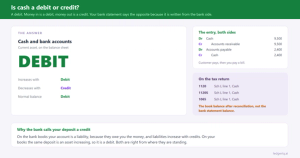
Expenses are debits. Every expense account increases with a debit, decreases with a credit, and carries a normal debit balance. Rent, wages, utilities, insurance, all of them.
The rule is one line. The part that costs firms time in February is which expense goes on which line of the return, and which ones are not deductions at all.
The short answer
Increases with: a debit. Recording any cost debits an expense account.
Decreases with: a credit. Refunds, rebates, corrections, and closing the account at year end.
Normal balance: debit. An expense account should carry a debit balance, printing as a positive number in a signed balance column.
Why it works that way, and the mnemonic that survives
Expenses reduce equity. Equity increases with credits, so anything that reduces it is a debit.
The memory device most people learn is DEALER:
Dividends, Expenses and Assets increase with a debit.
Liabilities, Equity and Revenue increase with a credit.
Six account types, two rules, no exceptions worth worrying about at this level. Draws and dividends sit with expenses in that list because both reduce equity, even though a draw is not an expense and never reaches the income statement. We cover that distinction properly on the owner draw page when it publishes.
The debit is only half the entry. The credit side says how the cost was settled: cash if you paid it, accounts payable if a bill arrived, accrued liabilities if neither has happened yet but the cost belongs in this year.
Journal entries, with numbers
Paying the monthly rent of 4,800.
- Debit Rent expense 4,800
- Credit Cash 4,800
Recording a utility bill of 760 that arrives before you pay it.
- Debit Utilities expense 760
- Credit Accounts payable 760
Paying a 12,000 annual insurance premium in July. The cost is not all this year's, so it starts as an asset.
- Debit Prepaid insurance 12,000
- Credit Cash 12,000
Expensing six months of that premium at December 31.
- Debit Insurance expense 6,000
- Credit Prepaid insurance 6,000
Accruing 3,150 of December repairs where the invoice arrives in January.
- Debit Repairs expense 3,150
- Credit Accrued expenses 3,150
A vendor rebate of 500 on a cost already expensed. This is one of the few times an expense account is credited in the normal course of business.
- Debit Cash 500
- Credit Repairs expense 500
How it looks on a trial balance export
Separate debit and credit columns. Expenses sit in the debit column, which is the same column as assets. The trial balance does not distinguish between an asset and an expense by position, only by where the account sits in the chart of accounts.
A single signed balance column. Expenses print as positive numbers. Revenue prints as negative. If an expense account is showing a credit balance, something is wrong, and there are only a few explanations: a refund larger than the costs recorded this year, a correction posted to the wrong account, or an amount that should have been capitalised being reversed out.
The check worth running on every file is subtotal by type. Expenses on a trial balance should foot to the expense total on the client's income statement. When they do not, an account has been typed into the wrong section of the chart of accounts, which is invisible on a trial balance and obvious on a profit and loss.
Where it goes on the tax return
This is where expenses stop being simple, because the return does not want one expense total. It wants specific costs on specific lines, and everything else summarised.
Form 1120 uses lines 12 through 26: compensation of officers on 12, salaries and wages on 13, repairs on 14, bad debts on 15, rents on 16, taxes and licenses on 17, interest on 18, charitable contributions on 19, depreciation on 20, depletion on 21, advertising on 22, pension and profit sharing on 23, employee benefit programs on 24, and everything else on line 26 as other deductions with a statement.
Form 1120S uses lines 7 through 20: officer compensation on 7, salaries and wages on 8, repairs on 9, bad debts on 10, rents on 11, taxes and licenses on 12, interest on 13, depreciation on 14, depletion on 15, advertising on 16, pension and profit sharing on 17, employee benefits on 18, and other deductions on line 20.
Form 1065 uses lines 9 through 21: salaries and wages on 9, guaranteed payments to partners on 10, repairs on 11, bad debts on 12, rent on 13, taxes and licenses on 14, interest on 15, depreciation on 16c, depletion on 17, retirement plans on 18, employee benefit programs on 19, and other deductions on line 21.
Three traps inside that.
Cost of goods sold is not an expense line. Direct materials, direct labour and other production costs go on Form 1125-A, not into page 1 deductions. Putting them in both places is a double deduction.
Officer compensation is its own line on the corporate forms. A single Payroll Expense account covering owners and staff has to be split, and it is the most common mapping failure on an 1120S.
Depreciation on page 1 is the tax figure from Form 4562, not the book depreciation in the trial balance, and the difference belongs on Schedule M-1. We covered that in book vs tax depreciation.
Expenses in the books that are not deductions
Worth its own section, because these are the ones that make the return different from the income statement.
Penalties and fines are recorded as expenses and are not deductible. Federal income tax paid by a C corporation is an expense in the books and not a deduction. Entertainment is not deductible, and business meals are subject to their own limitation. Life insurance premiums where the company is the beneficiary are not deductible. Political contributions are not deductible.
Each one is a permanent difference and each one belongs on Schedule M-1. Books that lump them into Miscellaneous Expense make a correct M-1 impossible to prepare, which is why the chart of accounts matters more than it looks.
Mistakes that throw it off
Owner draws coded to an expense account. The money left the bank, so the bookkeeper called it an expense. It is a distribution and belongs in equity. Coded as an expense it understates income and never reaches the distribution line, so both the income statement and the equity section are wrong at once.
Capitalisable assets expensed. A 9,000 machine in Repairs and Maintenance deducts in full this year and never appears on Schedule L, which throws the fixed asset rollforward and the depreciation schedule for every year after.
Personal spending run through the business. A deduction that does not exist, and a conversation with the client rather than a reclass you make silently.
Everything in Other Deductions. Technically allowed, since line 26 or 20 or 21 takes a statement. But a return where 80 percent of deductions sit in one line with a statement attached is harder to review, harder to defend, and loses the named lines a reviewer expects to see populated.
Where Ledger IQ fits
Expenses are where mapping earns its keep, because the trial balance has 60 expense accounts and the return has about 14 named lines plus a statement.
In Ledger IQ, each expense account maps to a named return line, Ln 13 Salaries and wages rather than a code you look up, with AI suggestions you review and approve. Multiple accounts map to one line while staying itemised, so five insurance accounts roll into the right line while keeping their detail in the workpaper.
The splits that cause the most trouble are decisions you make once and keep. Officer compensation separated from staff wages. Production costs mapped to Form 1125-A rather than page 1. Penalties and other nondeductible items mapped so they can be picked up on Schedule M-1 rather than disappearing into other deductions.
Because mapping memory carries forward, next season is a review of what changed rather than a full remap, and a new expense account surfaces in the mapping review as something to decide on instead of inheriting its neighbour's treatment. The Working Trial Balance then lets you click any return line and see every account feeding it, which is the check that catches a misfiled account before the return goes out rather than after.
Ledger IQ supports Forms 1065, 1120S and 1120, with exports for Drake, Lacerte and UltraTax CS. Your first return is free, so you can try it at portal.ledgeriq.ai on a live client without a credit card.