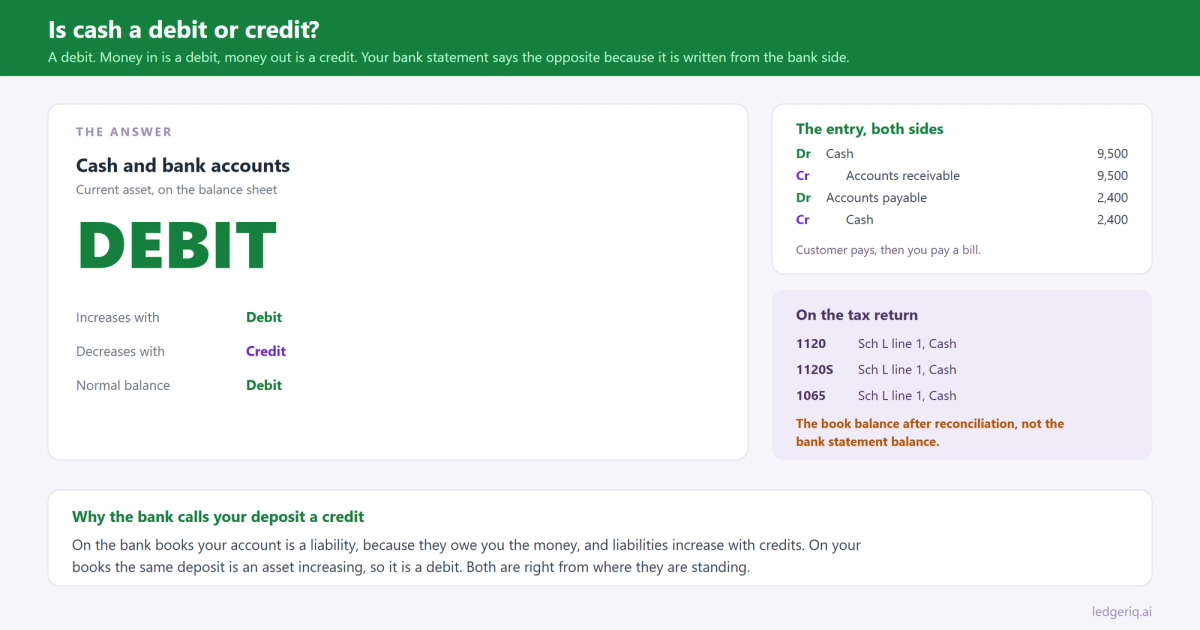
Cash is a debit. It is an asset, so money coming in is a debit and money going out is a credit, and the account carries a normal debit balance.
The confusion is not the rule. It is the bank statement, which calls a deposit a credit, and the client who reads their statement and tells you your books are backwards.
The short answer
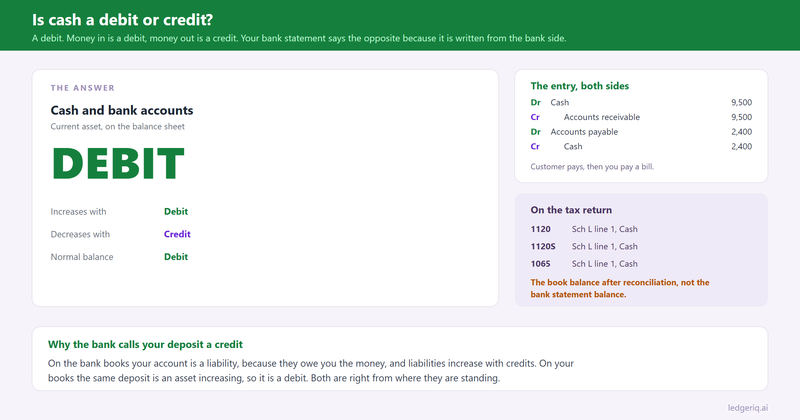
Increases with: a debit. Deposits, customer payments, loan proceeds and owner contributions all debit cash.
Decreases with: a credit. Checks, transfers, fees and withdrawals all credit cash.
Normal balance: debit. A bank account should carry a debit balance, which prints as a positive number in a signed balance column.
Why the bank says the opposite
This is the part worth getting straight, because it comes up with every client who has looked at their own statement.
Your books are your records. The bank's statement is the bank's records. When you deposit 5,000, the bank now owes you 5,000, so on the bank's books your account is a liability and a liability increases with a credit. They credit your account and tell you so.
On your books, that same deposit is an asset increasing, so you debit cash.
Both are correct from where they are standing. The statement is written from the bank's point of view, which is why the words are inverted, and why explaining it once to a client saves the same conversation three more times.
Journal entries, with numbers
Depositing a customer payment of 9,500.
- Debit Cash 9,500
- Credit Accounts receivable 9,500
Paying a vendor bill of 2,400.
- Debit Accounts payable 2,400
- Credit Cash 2,400
Recording a bank service charge of 38 found during the reconciliation.
- Debit Bank charges expense 38
- Credit Cash 38
Transferring 15,000 from operating to savings. Both sides are cash accounts, which is why a transfer should never touch income or expense.
- Debit Cash, savings 15,000
- Credit Cash, operating 15,000
Reimbursing petty cash of 420 at year end.
- Debit Office supplies and other expenses 420
- Credit Cash 420
How it looks on a trial balance export
Separate debit and credit columns. Cash sits in the debit column. Every bank account appears as its own line if the client set them up that way, which is what you want.
A single signed balance column. Cash prints as a positive number. A negative tells you the account is overdrawn on the books, which is the one case worth real attention.
Three checks before you use the number.
Each bank account should tie to its reconciliation. Not to the bank statement, to the reconciliation: statement balance, plus deposits in transit, less outstanding checks, equals the book balance. A client who has never reconciled has a cash figure that is a guess, and everything downstream inherits it.
Undeposited Funds is not cash. It is a holding account for payments received and not yet taken to the bank. A balance that only ever grows is usually double counted revenue, which we worked through in clearing Undeposited Funds.
Stale uncleared checks. Checks written years ago that never cleared are still reducing book cash. They are either lost, void, or someone else's problem under escheat rules, and none of those is resolved by leaving them there.
Where it goes on the tax return
Cash is the first line of the balance sheet.
- Form 1120: Schedule L line 1, Cash
- Form 1120S: Schedule L line 1, Cash
- Form 1065: Schedule L line 1, Cash
Beginning and ending columns, at book, and it is the sum of every operating account, savings account and petty cash fund the entity holds.
Two things that decide whether the number belongs there.
A negative cash balance is reported as a liability, not as negative cash. If the books show the operating account overdrawn at year end because checks were written against funds that had not arrived, that overdraft is a current liability on Schedule L. Reporting negative cash on line 1 is both wrong and conspicuous.
Worth separating two different things here. A book overdraft is a negative balance created by outstanding checks you have written but the bank has not yet paid. The bank account itself is positive. That belongs reclassified to liabilities. A true overdraft, where the bank has actually advanced funds, is a borrowing and belongs with short term debt.
Accounts that are not cash do not belong on line 1. Money market funds may be fine. Certificates of deposit, investments and amounts held by a payment processor are not cash in the Schedule L sense, and lumping them in overstates the line and understates whatever line they actually belong on.
Cash is also the reason the method question matters. On a cash basis return, income is recognised when it hits the bank and expenses when they leave it, which is a different return from the same books on accrual. We covered the conversion in converting cash basis books to accrual.
Mistakes that throw it off
Recording transfers between accounts as income and expense. Moving 15,000 from operating to savings is not revenue and not a deduction. Done repeatedly, it inflates both sides of the income statement while net income stays right, which is why nobody notices.
Using the bank balance instead of the book balance. They differ by deposits in transit and outstanding checks, and the difference at year end is often material. Schedule L wants the book balance after a proper reconciliation.
Netting a negative account against a positive one. Two bank accounts, one overdrawn, reported as a single net figure hides a liability the balance sheet is supposed to show.
Treating personal spending through the business account as an expense. It is a distribution or a draw, and it belongs in equity. This one changes taxable income, and it is the most common cash related error on a small business return.
Posting journal entries straight to cash. Cash should move because a transaction happened. An adjusting entry to cash with no corresponding bank activity means the reconciliation is being forced, which is a different problem wearing a journal entry's clothes.
Where Ledger IQ fits
Cash looks like the easy line on Schedule L, and it is, right up to the point where a bank account is overdrawn or a payment processor balance is sitting in the middle of it.
In Ledger IQ, every cash account maps to Schedule L line 1 as a recorded decision, and accounts that are not cash map somewhere else on purpose rather than by default. Multiple accounts map to one line while staying itemised, so six bank accounts keep their identity in the workpaper while line 1 carries the total.
When a balance has to move, an overdrawn account reclassified to current liabilities, a processor balance moved to other current assets, it goes in as a numbered reclassifying entry with its own description. It shows on the Working Trial Balance next to the unadjusted balance, so the decision is documented rather than made silently in the client's file.
And because year over year rollforward puts last year's balances beside this year's, a cash balance that moved in a way the business cannot explain is visible as a comparison, which is usually the first sign that the reconciliation was not really done.
Ledger IQ supports Forms 1065, 1120S and 1120, with exports for Drake, Lacerte and UltraTax CS. Your first return is free, so you can try it at portal.ledgeriq.ai on a live client without a credit card.