Form 7203 is four pages of arithmetic that the IRS used to let you do on a napkin.
For years, S corp shareholder basis lived in a worksheet somewhere. Maybe in the tax software. Maybe in a spreadsheet named "basis FINAL v3.xlsx." Maybe, if we are being honest about our profession, nowhere at all. Then the IRS made it a real form, and a lot of firms discovered they had been carrying a number forward that nobody had actually computed since the Obama administration.
Here is what the form wants, in what order, and where people get it wrong.
First: basis is not the same thing as AAA
This is the single most common mix-up, so let us kill it early.
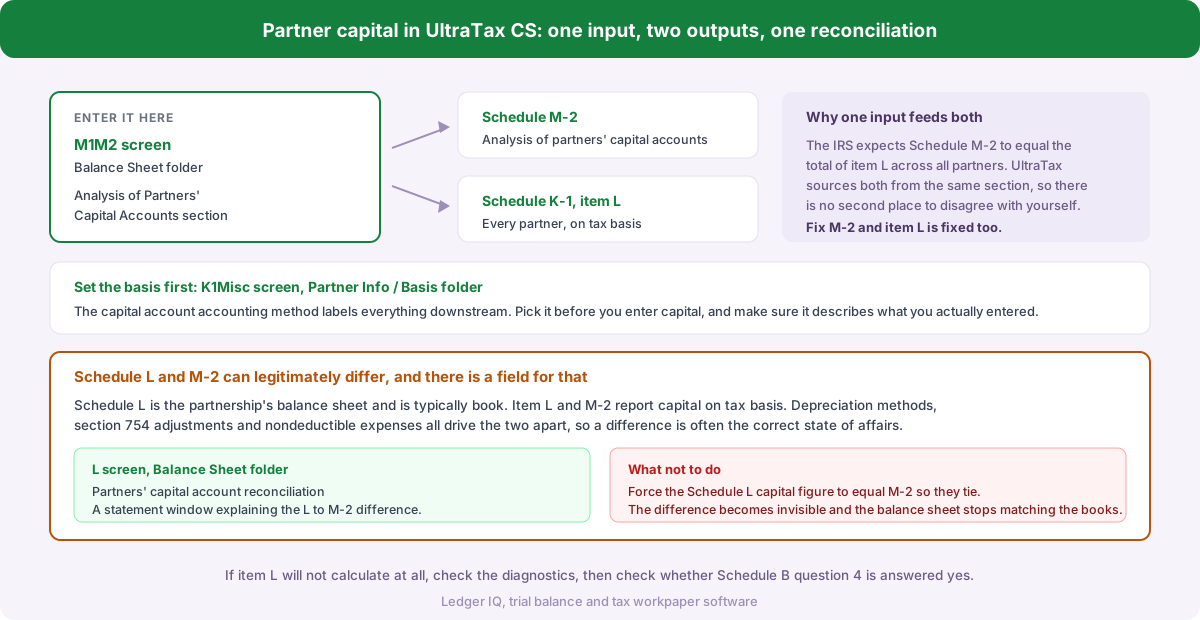
AAA is a corporate account. One per company. It lives on Schedule M-2 and it tracks the S corporation's undistributed income. There is exactly one AAA no matter how many shareholders you have.
Basis is a shareholder account. One per person. It determines whether that specific shareholder can deduct a loss, whether a distribution is taxable to them, and what their gain is when they sell.
They move in similar directions and they are almost never the same number. Tax-exempt income increases basis but stays out of AAA. Nondeductible expenses reduce both, but on different schedules. A shareholder who bought in three years ago has a completely different basis from the founder, while they share the same AAA.
If you find yourself pulling the AAA balance and calling it basis, stop.
Who actually has to file it
Form 7203 gets attached to the shareholder's 1040, not the 1120S. It is required when the shareholder does any of these:
Claims a deduction for a loss from the S corp. Receives a distribution that is not a dividend. Disposes of stock. Receives a loan repayment from the corporation.
Notice what is on that list: distributions. Almost every profitable small S corp distributes something. So "I only need this when there is a loss" is wrong, and it is a common wrong.
The ordering rules, which is where the money is
Basis adjustments happen in a specific sequence, and the sequence changes the answer. Get it out of order and you will over-deduct a loss or under-report a taxable distribution.
1. Add income first. All separately and non-separately stated income items. This includes tax-exempt income, which is easy to forget precisely because it is not taxable.
2. Subtract distributions second. Before losses. This trips people up constantly, because intuitively you want to run the P&L first and hand out what is left. The code does not care about your intuition. Distributions come out before losses.
3. Subtract nondeductible expenses third. Meals disallowance, penalties, the personal portion of things.
4. Subtract losses and deductions last. Whatever basis survives steps one through three is what is available to absorb losses.
The practical consequence of step two coming before step four: a shareholder can take a distribution that is entirely tax-free, and then find that the loss they were counting on is suspended because there is no basis left to absorb it. Same year. Same company. The distribution ate the basis first.
That is the conversation nobody wants to have in April, and it is entirely avoidable in November.
Stock basis and debt basis are two buckets
Keep them separate, because the rules differ.
Stock basis is what you get from contributions and income. Debt basis comes from loans the shareholder personally makes to the corporation. Guaranteeing a bank loan does not create debt basis, and this is one of the most expensive misunderstandings in small business tax. The shareholder has to be the actual lender.
Losses run against stock basis first. Once stock basis hits zero, remaining losses can run against debt basis. Neither can go below zero.
And here is the part that catches people the following year: once debt basis has been reduced by losses, repayment of that loan produces income to the shareholder. The loan repayment is not just a return of principal anymore. Some of it is gain.
Zero is the floor
Basis never goes negative. When losses exceed basis, the excess does not disappear, it suspends and carries forward until basis is restored by future income or contributions.
Which means the carryforward has to be tracked, year over year, per shareholder. Forever. This is the part that makes Form 7203 feel less like a form and more like an accusation, because it asks you to produce a number that depends on every prior year being right.
Why the first year of doing this properly hurts
If your predecessor tracked basis in a worksheet that no longer exists, or tracked it wrong, or never tracked it, you are reconstructing. That means going back to the year of the S election, or the year the shareholder bought in, and rolling forward every year of income, distributions, and nondeductible items since.
For a ten-year-old company that is a genuinely miserable afternoon. But it is an afternoon that gets worse every year you postpone it, and it becomes someone else's emergency when the shareholder sells.
Do it once. Write it down somewhere durable. The second year takes ten minutes.
Where the numbers actually come from
Every input on Form 7203 traces back to the K-1, and every number on the K-1 traces back to the trial balance. Ordinary business income in Box 1. Separately stated items in Boxes 2 through 12. Distributions in Box 16 code D. Nondeductible expenses in Box 16 code C. Tax-exempt income in Box 16 code A or B.
Which means basis is only as good as the return that fed it, and the return is only as good as the mapping that fed that.
This is where Ledger IQ fits. You upload the client's trial balance, map each account to a real line on the 1120S, and the workpaper proves it before anything gets exported. The income proof walks net income per books through your book to tax differences down to ordinary business income, which is the number that lands in Box 1 and then becomes the top line of every shareholder's basis computation.
Distributions get mapped to the distribution line rather than buried in an expense account, which matters more than it sounds. Owner draws coded to "Miscellaneous Expense" are the single most common reason a basis computation is quietly wrong. Nondeductible items post as tax journal entries with their own M-1 offset, so they show up where the basis worksheet expects to find them instead of being netted into something else.
Get the trial balance right and Form 7203 is arithmetic. Get it wrong and Form 7203 is arithmetic performed confidently on the wrong inputs, which is worse than no form at all.
Ledger IQ supports Forms 1065, 1120S and 1120, with exports for Drake, Lacerte and UltraTax CS. Your first return is free, so you can try it at portal.ledgeriq.ai on a live client without a credit card.