Partner Capital Accounts on Form 1065: Tax Basis, Schedule L and M-2
Two questions account for most of the time spent on the back end of a partnership return. Why does not the balance sheet tie to the partners' capital accounts, and which number is supposed to be on the K-1?
Here is the short version. Schedule M-2 line 9 must equal the total of every partner's ending capital in Item L of the K-1s. Both are on tax basis. Schedule L line 21 is the balance sheet, prepared on the basis the partnership keeps its books, which for most firms is book basis. So M-2 and the K-1s have to agree with each other, and neither of them has to agree with Schedule L.
Every major tax package defaults to pushing the tax basis figure into Schedule L line 21 anyway. That default is the source of most of the confusion, and the fix is different in each product.
What has to tie, and what does not
Three numbers, two relationships.
Schedule M-2 line 9 and the sum of Item L ending capital across all K-1s: these must be equal. The instructions are explicit that line 9 should equal the total of the amounts reported as the partners' ending capital accounts in item L of all the partners' Schedules K-1. Both are tax basis figures. If they disagree, an allocation is wrong, and it is arithmetic rather than judgment.
Schedule L line 21 and the other two: these agree only when the books are kept on tax basis. Schedule L is the balance sheet per books, and the instructions say the balance sheet should be prepared on the same basis of accounting used in keeping the partnership's books and records. A partnership on GAAP reports GAAP equity on line 21, and it will differ from tax capital by the cumulative book to tax differences.
That second point is where practitioners, and more than one software knowledge base, state that line 21 must equal M-2 line 9. It is true for a partnership whose books are on tax basis, which is a large share of small partnerships. It is not a rule, and treating it as one is how a tax basis number ends up sitting on a book balance sheet with nothing documenting the swap.
Item L has to be tax basis
Since the 2020 tax year, partner capital accounts reported on Item L of Schedule K-1 must be on tax basis. Not GAAP. Not section 704(b) book capital. Not whatever the client's QuickBooks equity section happens to say.
Schedule L, meanwhile, is the balance sheet, and it comes from the books the client actually keeps.
So when the equity on Schedule L does not equal the sum of the partners' Item L capital accounts, that is frequently correct. What is not acceptable is being unable to explain the difference.
The usual drivers:
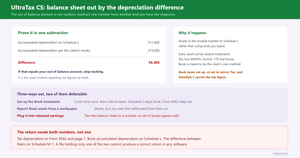
Book versus tax depreciation. If the books carry straight line depreciation and the return claims bonus or section 179, book equity and tax capital diverge by the cumulative difference, and they stay diverged for the life of the assets. This is the largest reconciling item on most returns, and we covered the mechanics in book vs tax depreciation.
Nondeductible expenses. Disallowed meals, entertainment, fines, officer life insurance. These reduce tax capital, and whether they also reduce book equity by the same amount in the same year depends on how the books were kept.
Book reserves that tax does not recognise. An allowance for doubtful accounts reduces book equity. Tax capital follows the specific charge off, so the reserve is a reconciling item until the debt is actually written off.
Section 754 step up adjustments, which exist for tax purposes and typically not on the client's books at all. Worth knowing that a section 743(b) basis adjustment belongs to the partner rather than the partnership, and Item L capital is reported without it.
Syndication costs, which reduce capital and are never deductible.
The roll every partner's capital account follows
Each partner's Item L works the same way:
Beginning capital account, plus capital contributed during the year, plus that partner's share of income or loss, less withdrawals and distributions, equals ending capital account.
Two verifications catch most errors.
Each partner's beginning capital must equal that partner's ending capital on last year's K-1. If it does not, either the prior year was wrong or something was lost in the rollforward. This is the partnership equivalent of the beginning balance problem that breaks corporate balance sheets, and like that one, it survives e-filing without complaint.
The partners' capital columns must sum to Schedule M-2. If the individual columns do not add to it, an allocation is wrong somewhere.
A worked example: three partners, one year
Numbers make this concrete. Take a partnership with three partners, sharing profits 50, 30 and 20 percent.
The year produced 240,000 of ordinary business income after an 80,000 guaranteed payment to partner A, 6,000 of separately stated interest income, and 9,000 of nondeductible expenses. Partner C contributed 25,000 in March. The partnership distributed 150,000 in total.
Partner A, 50 percent. Beginning 180,000, plus income 120,000, plus interest 3,000, less nondeductible 4,500, less distributions 75,000. Ending 223,500.
Partner B, 30 percent. Beginning 108,000, plus income 72,000, plus interest 1,800, less nondeductible 2,700, less distributions 45,000. Ending 134,100.
Partner C, 20 percent. Beginning 72,000, plus a 25,000 contribution, plus income 48,000, plus interest 1,200, less nondeductible 1,800, less distributions 30,000. Ending 114,400.
The three ending balances total 472,000, and that figure has to appear on Schedule M-2 line 9. Check it the other way: 360,000 of beginning capital, plus 25,000 contributed, plus 246,000 of income items, less 9,000 nondeductible, less 150,000 distributed, is 472,000.
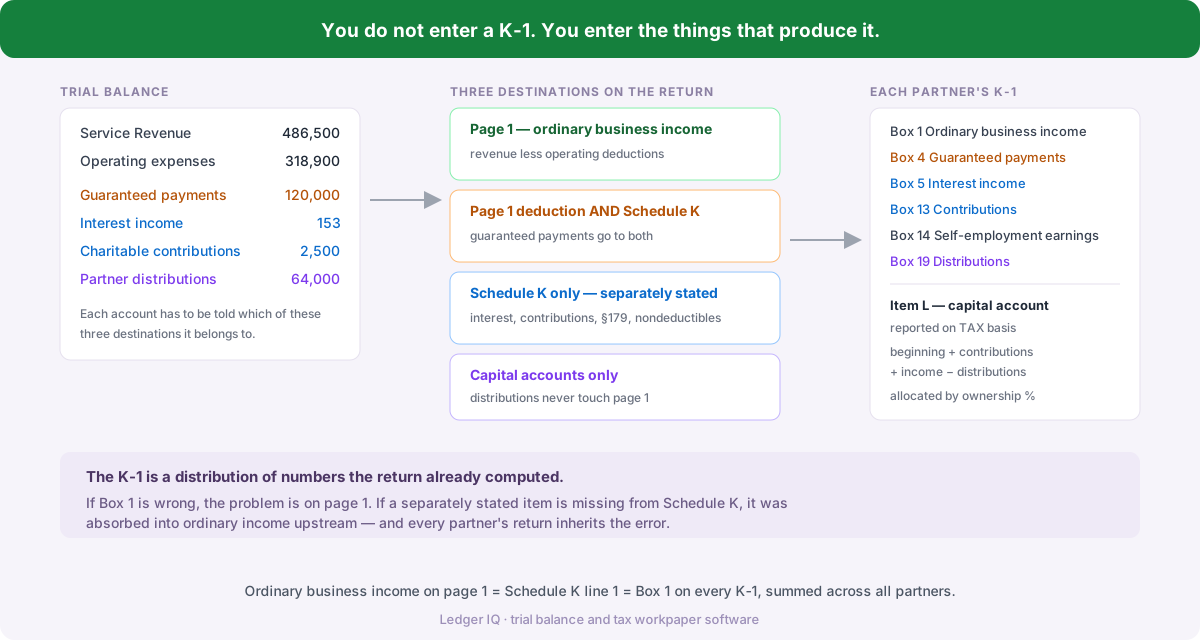
Note what is not in the roll. The 80,000 guaranteed payment to partner A does not appear as a distribution. It was deducted on page 1, it reduced the ordinary income that was allocated to all three partners, and partner A reports it in Box 4. Treating it as a withdrawal is the single most common way a capital roll goes wrong, because the arithmetic still foots.
Bridging to the balance sheet
Now the part the competing pages skip. The partnership keeps its books on GAAP. Schedule L line 21 is not 472,000.
Start at tax capital and work to book equity:
- Total tax basis capital per Item L: 472,000
- Add cumulative excess of tax depreciation over book depreciation: 55,800
- Deduct the book allowance for doubtful accounts, which tax does not recognise: 12,000
- Book equity reported on Schedule L line 21: 515,800
That 43,800 difference is not an error. It is the reconciliation, and it belongs in your workpaper file. Next year it will be a different number, because the depreciation difference reverses over time and the allowance moves with the receivables.
The return itself gives you nowhere to show this, which is exactly why preparers assume one of the two numbers must be wrong. Keep the bridge as a workpaper, and the question answers itself at review and again next February.
Entering it in your software
Every major package computes Schedule L line 21 from Schedule M-2, which is tax basis. If the books are on tax basis, nothing to do. If they are not, you override, and the fields differ.
UltraTax CS
The balance sheet lives on the L screen in the Balance Sheet input folder. Use the Partners' capital accounts (Force) field to report the book figure on line 21.
Where the forced amount and the M-2 figure differ, use the Partners' capital account reconciliation statement window to explain it, and check the M1M2 screen in the same folder, which carries a Net income per books (Force) field driving M-2 line 3.
Lacerte
Schedule L line 21 is computed from Schedule M-2 line 3. If the balance sheet is kept on a book or GAAP basis, override the ending partners' capital accounts on Screen 24, Balance Sheet, with the book amount from the partnership's records.
Without that override the program uses the M-2 figure, so the balance sheet reports tax capital. The optional recompute checkbox that existed on Screen 28, Schedule M-2 (Capital Account) for the 2020 tax year has been removed, so the Screen 24 override is the current answer.
ProConnect Tax and ProSeries
Partners' capital on the balance sheet is calculated automatically from Schedule M-2, and an override sits at the end of the balance sheet section. In ProConnect, go to Input Return, then Balance Sheet, M-1, M-2, then Balance Sheet.
This is the behaviour behind the long running community thread about reporting tax basis capital on the K-1 while keeping a GAAP balance sheet. The answer is the override, and the discipline is documenting what the difference represents rather than leaving it as an unexplained number.
Drake Tax
Partner capital is entered per partner in section L, Analysis of Capital Account, on the K1 screen: the beginning capital account amount, and capital contributed during the year as cash contributed and as adjusted basis of property contributed. Those flow to Schedule M-2 lines 1, 2a and 2b.
An entry on the L screen for line 21 affects the balance sheet. When the beginning figures disagree, Drake produces Return Note 044, which means Schedule L line 21 and Schedule M-2 line 1 do not agree at the start of the year. In View mode the WK_PCAR and WK_M2 worksheets show how the program built each figure.
One Drake specific warning. Autobalance will force the balance sheet to agree by adjusting capital, which hides exactly the difference you are trying to document. Turn it off on the PRNT screen while you work, as covered in fixing a Drake Schedule L that is out of balance.
Where the numbers in the roll come from
Contributions are new money or property the partner put in. They are not income and never touch page 1.
Share of income or loss is the partner's allocated portion of everything the return produced, ordinary business income plus their share of the separately stated items. Not just Box 1.
Withdrawals and distributions are money or property taken out. They reduce capital and are not deductible.
The item most often misplaced here is the guaranteed payment. It is not a distribution and does not belong in the withdrawals line of the capital roll. It is deducted on page 1 and reported in Box 4, and it affects the capital account only through its effect on income.
When beginning tax capital is unknown
Partnerships that had always kept book capital faced a transition when tax basis reporting became mandatory, and some files still carry the scar.
For that first year, the IRS allowed a beginning balance to be determined under one of several methods: the tax basis method itself, the modified outside basis method, the modified previously taxed capital method, or the section 704(b) method. After that, the account rolls forward transactionally, which means this year's beginning balance is last year's ending balance and nothing else.
If you inherit a file where beginning capital was never properly established, that is a reconstruction project rather than a plug. Partners' basis records, prior returns and the original contribution history are where it comes from.
What happens when capital goes negative
A partner's capital account can legitimately go negative. Losses and distributions in excess of contributions will do it.
A partner cannot deduct losses beyond their basis, which includes their share of partnership liabilities. That is why the liability allocations on the K-1 matter, and why a partner with a negative capital account may still be able to deduct losses if they have debt basis. We covered how those liabilities are allocated in K-1 Item K recourse vs nonrecourse, and the difference between capital and basis in partner basis vs capital account.
A negative capital account is a flag worth investigating rather than an error to fix by plugging. It usually signals distributions in excess of basis, which can be a taxable event to the partner, and that is a conversation to have before the return is filed. The full treatment is in what a negative tax basis capital account means.
When you can skip Schedule L entirely
Schedule B question 4 excuses a partnership from completing Schedules L, M-1 and M-2, and Item L on the K-1s, when all of its conditions are met: total receipts for the year under 250,000, total assets at year end under 1 million, Schedules K-1 filed with the return and furnished to the partners by the due date including extensions, and the partnership is not required to file Schedule M-3.
Two things worth knowing about that relief. Answering the question incorrectly to avoid the work is a misrepresentation on the return. And skipping the balance sheet this year means there is nothing to carry forward when the partnership grows past the threshold. Reconstructing beginning capital accounts several years later, for partners who may have changed, is significantly harder than maintaining them.
Many firms complete the balance sheet regardless, for exactly that reason.
The checks before it goes out
Add every partner's Box 1 together and confirm it equals ordinary business income on page 1. Do the same for the separately stated items against their Schedule K lines.
Confirm each partner's beginning capital equals their prior year ending capital.
Confirm the partners' capital columns sum to Schedule M-2 line 9.
Confirm that Schedule L line 21 either equals M-2 line 9, because the books are on tax basis, or differs by an amount your bridge explains. If it differs and you cannot name the pieces, that is the one to resolve before filing. A Schedule L that will not balance for other reasons is worked through in Schedule L is out of balance.
Those checks catch nearly everything that goes wrong in partnership equity, and all but the last are arithmetic rather than judgment.
Getting the inputs right upstream
Capital account reporting is downstream work. The roll is only as good as the income allocated into it and the classification of the transactions that moved capital.
Ledger IQ handles that upstream half. Distributions map to their own named return line and never touch page 1. Guaranteed payments map to page 1 line 10, distinct from distributions, so the two cannot be confused in the trial balance. Partner draw accounts stay itemised per partner while the line total reaches the return, which is what the per partner roll needs.
Book to tax differences go in as tax journal entries. TJEs move the tax balance column of the Working Trial Balance without touching the book figures, so the workpaper carries book equity, the reconciling items and tax capital as separate visible numbers. That is the bridge above, maintained as part of the file rather than rebuilt from memory each February.
For beginning balances, prior year figures carry forward with the rollforward, and the return tie out compares each line against the return as filed, so a beginning capital account that does not match last year's K-1 is flagged before the return goes out rather than discovered next year.
Ledger IQ supports Forms 1065, 1120S and 1120, with exports for Drake, Lacerte and UltraTax CS. Your first return is free, so you can try it at portal.ledgeriq.ai on a live client without a credit card.