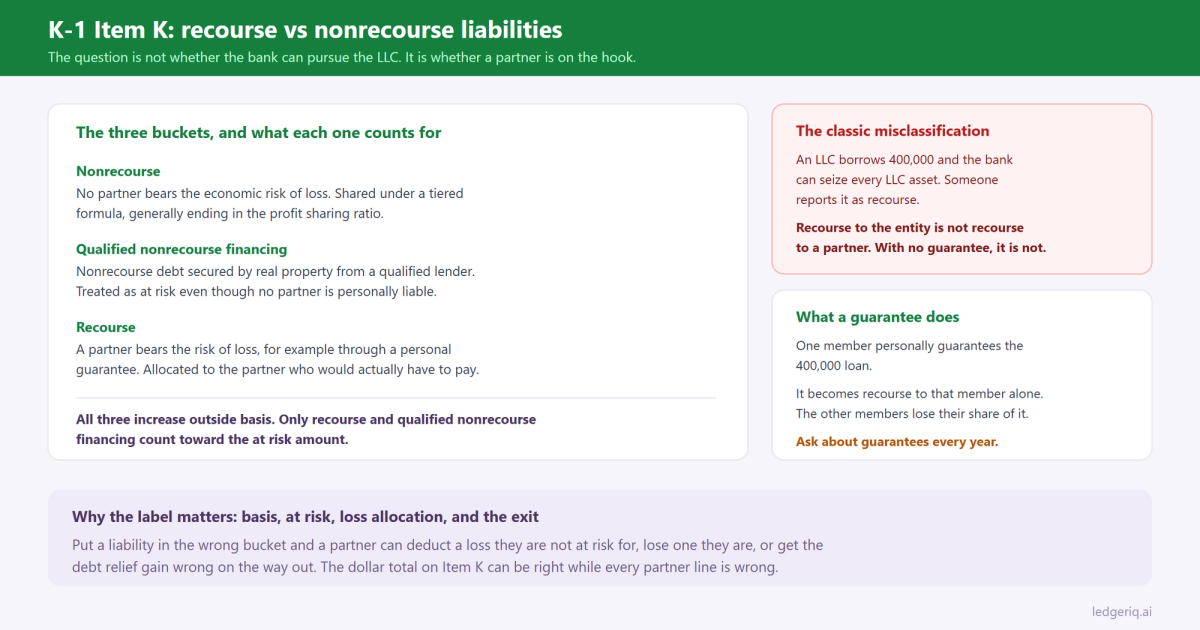
An LLC borrows 400,000 from a bank. The loan agreement lets the bank seize every asset the LLC owns if it defaults. So somebody fills in Item K on each member's K-1 and puts the member's share under recourse.
That is wrong, and it is one of the most common errors on a partnership return. The bank having recourse against the entity says nothing about whether any partner bears the risk.
Item K is not asking what the lender can do. It is asking who ultimately pays.
What Item K reports
Item K on Schedule K-1 shows the partner's share of partnership liabilities at the beginning and end of the year, in three buckets: nonrecourse, qualified nonrecourse financing, and recourse.
There are also checkboxes, including one flagging liabilities subject to guarantees or other payment obligations by the partner, and one for liabilities coming up from lower tier partnerships.
The totals are usually easy. The partnership knows how much it owes. The hard part is the split, both between buckets and between partners, and that is where the errors live.
Recourse means a partner is on the hook
A liability is recourse to the extent a partner bears the economic risk of loss for it.
The test is a hypothetical liquidation. Imagine every partnership asset, including cash, became worthless, and every liability came due at once. Who would be legally obligated to pay, with no right of reimbursement? That partner bears the risk, and the liability is allocated to them as recourse.
In a general partnership, general partners are liable for partnership debts, so ordinary partnership borrowing tends to be recourse to them. In an LLC, members are generally not personally liable for the company's debts, so the same borrowing is generally not recourse to any member, unless something shifts the risk onto a specific person.
The most common thing that shifts it is a personal guarantee.
What a guarantee does
When one member personally guarantees the 400,000 loan, that member now bears the economic risk of loss. The liability becomes recourse, and it is allocated to that member alone.
The other members, who had been sharing that debt, lose their share of it. Their basis drops, and a basis drop from a reduction in allocated liabilities is treated as a distribution of money to them. If their basis was already thin, a guarantee signed by somebody else can produce gain for them.
That is why guarantees need to be asked about every single year, not just at formation. Banks ask for guarantees at renewal, on new credit lines, and whenever a covenant is breached. The member who signed often does not think to tell the accountant, and the K-1s go out allocating the debt the old way.
Nonrecourse means nobody is personally on the hook
A liability is nonrecourse when no partner bears the economic risk of loss. The LLC bank loan with no guarantee is the everyday example.
Nonrecourse liabilities are allocated by a tiered formula. The first tiers follow the minimum gain the debt creates and certain built in gain on contributed property. What remains, which is usually most of it for a simple partnership, is generally allocated in proportion to how partners share profits.
For a straightforward operating partnership that means nonrecourse debt usually follows the profit sharing ratio. The complications arise with property financed by the debt, depreciation driving losses, and contributed property carrying built in gain.
Qualified nonrecourse financing is a subset that matters for at risk
Qualified nonrecourse financing is nonrecourse debt secured by real property used in the activity, borrowed from a qualified person such as a bank, where no one is personally liable.
It gets its own bucket because of the at risk rules, not basis. Ordinary nonrecourse debt does not count toward a partner's amount at risk. Qualified nonrecourse financing does. For real estate partnerships that distinction is the difference between a deductible loss and a suspended one.
Why the label matters
All three buckets increase a partner's outside basis. That is the reason partners can deduct losses funded by partnership borrowing, and why their basis can stay positive when their capital account goes negative.
But the buckets are not interchangeable for anything else.
For at risk, recourse and qualified nonrecourse financing count, ordinary nonrecourse debt does not. Mislabel a nonrecourse loan as recourse and a partner deducts a loss they are not at risk for.
For loss allocation, deductions financed by nonrecourse debt follow their own allocation rules. Mislabel the debt and the losses can land on the wrong partner.
For the exit, a partner who leaves is treated as receiving money equal to the liabilities they are relieved of. The wrong allocation means the wrong gain on the way out, possibly for every departing partner for as long as the error persists.
And unlike every other flow through entity your firm handles, this is specific to partnerships. S corporation shareholders get no basis from company debt at all, even with a personal guarantee. We covered what that means in S corp distributions in excess of basis.
The totals can be right while every line is wrong
The most dangerous version of this error is invisible. The partnership owes 400,000, the K-1s allocate 400,000 in total, and the partnership level numbers tie perfectly.
But the whole amount is labeled recourse and split pro rata when it should be nonrecourse split by profits, or recourse to one guarantor. Nothing on the return disagrees with anything else. Each partner's basis, at risk amount and future exit gain are wrong, and there is no reconciliation that catches it because the aggregate is correct.
The only check is the question: for each liability on the balance sheet, is any partner personally obligated, and who?
Where Ledger IQ fits
Item K starts with knowing what the partnership actually owes, liability by liability, which is a balance sheet question before it is an allocation question.
In Ledger IQ each liability account maps to its Schedule L line and stays itemised rather than collapsing into a single total, so the line of credit, the equipment note, the mortgage and the loan from a member each remain visible as separate balances. That is the list you need in front of you when you ask which of them carry a guarantee.
Loans from partners map separately from third party debt, because a member who lends money to the partnership bears the risk on that loan directly, and it should never be netted into bank borrowing.
Year over year rollforward shows each liability's prior balance beside the current one, so a new credit facility, the kind that usually arrives with a fresh guarantee, stands out as a new line rather than as an increase buried in a total. That is the prompt to ask the question every year instead of only at formation.
Ledger IQ supports Forms 1065, 1120S and 1120, with exports for Drake, Lacerte and UltraTax CS. It is free during early access, so you can try it at portal.ledgeriq.ai on a live client without a credit card.