Part of our guide to Trial Balance Software for Tax Preparation: 7 Options Compared.
Most business returns prepared in Lacerte are still keyed in by hand. The trial balance sits in Excel on one screen, Lacerte's input screens sit on the other, and someone spends the better part of an hour moving numbers across, gross receipts, then cost of goods sold, then thirty expense lines, then the balance sheet, then a fight with Schedule L.
Here is the order that produces the least rework, the Lacerte behaviors worth knowing before you start, and the specific reasons the balance sheet does not tie when you get to the end.
Work in the order the return computes, not the order the trial balance is printed
Trial balances print in account-number order: assets, liabilities, equity, income, expenses. Entering them in that order means entering the balance sheet before the return has computed the net income the balance sheet depends on, which guarantees you will come back to it.
Income and cost of goods sold first. Gross receipts, returns and allowances, other income. Cost of goods sold has its own detail (beginning inventory, purchases, cost of labor, ending inventory), and the ending inventory figure has to be the same number you later put on the balance sheet. When those two disagree, nothing errors; the return is just internally inconsistent, and it is exactly the sort of thing a reviewer catches after you have moved on.
Deductions next. Most of the trial balance ends up here. Two categories need thought rather than typing:
Officer compensation is separate from salaries and wages on a corporate return and reports on its own form. If a shareholder-employee's pay ran through the same payroll account as everyone else's, it still has to be split out.
Depreciation should come from Lacerte's asset entries, not from the trial balance. If the client's assets are in the depreciation module, Lacerte computes the deduction; typing the book depreciation number into a deduction field on top of that double-counts it. Enter the assets, let Lacerte calculate, and treat the difference between book and tax depreciation as a Schedule M-1 item.
Schedule K items before the balance sheet. Interest income, dividends, charitable contributions, section 179, nondeductible expenses. These come off page 1 and flow to the K-1s. They also affect the accumulated adjustments account, which affects equity, which is why they belong before Schedule L rather than after.
Balance sheet last, both columns.
Let Lacerte's diagnostics do the work
The most useful habit in Lacerte is checking diagnostics early and often rather than at the end. Lacerte will tell you the balance sheet is out of balance, and it will tell you before you have spent twenty minutes hunting. Critical diagnostics also block e-file, so anything in that list has to be resolved regardless.
The second habit worth building: when a return is carried forward from last year, verify the proforma'd beginning balances rather than trusting them. Proforma brings prior-year ending balances into this year's beginning column, which is enormously helpful, and completely wrong if last year's return had an error in it. Beginning balances inherit prior mistakes silently.
Why Schedule L will not balance
Six causes account for nearly all of it.
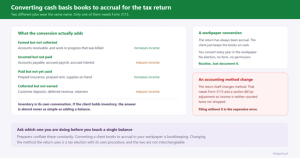
No beginning column. A new client, or a client whose prior return did not complete the balance sheet because they were under the reporting threshold. There is nothing to proforma, so the beginning column has to be reconstructed from the prior year's books or the prior return's supporting schedules.
[img:lacerteL]
Beginning accumulated depreciation left out. Fixed assets get entered at cost in the beginning column and the accumulated depreciation line below them gets skipped. If the prior return ended with $58,000 of accumulated depreciation, you are out of balance by exactly $58,000, and that number appears nowhere on the current-year trial balance, which is why it is hard to spot by re-reading.
Retained earnings entered rather than derived. On an 1120-S, ending equity is beginning retained earnings plus net income less distributions, and it has to agree with Schedule M-2 and the AAA. Typing the ending retained earnings figure off the trial balance while skipping distributions leaves the balance sheet mathematically unable to tie.
Distributions never entered. They sit in equity on the trial balance, never touch page 1, and are the single easiest thing to skip. They belong on Schedule K and Schedule M-2 and they reduce ending equity.
Page 1 is not finished. Schedule L depends on the net income the return computed. If a deduction is missing, the balance sheet is out by exactly that amount. Finishing income and deductions first means the difference you are chasing is a real balance sheet difference.
Rounding. Whole dollars against a trial balance with cents produces a dollar or two. If everything above checks out, that is usually what remains.
The efficient move when the balance sheet is out: take the difference and go looking for that exact number, or half of it, in the trial balance. A $58,000 difference is one missing account. A difference equal to exactly twice an account balance is a sign entered backwards. Scanning for the number beats re-reading every line.
The items that should never be typed as smaller numbers
If the client has $8,940 of business meals, the deduction line does not get $4,470.
The full amount is the expense; the 50% disallowance is a book-to-tax difference that belongs on Schedule M-1 and on Schedule K as a nondeductible expense, where it reduces AAA and each shareholder's stock basis. Halving the number in data entry gets you the right taxable income and the wrong AAA, the wrong basis, and a K-1 that misstates what the shareholder needs for their own return.
The same applies to entertainment (fully disallowed since the TCJA), officer life insurance premiums, fines and penalties, and the book-versus-tax depreciation difference. They are reconciling items. They are not smaller deductions.
What manual entry actually costs
Two hundred fields, two hundred chances to transpose a digit. A transposition on page 1 does not break the balance sheet, so nothing catches it, the return simply reports a number the client's books do not support.
The larger cost is that none of the work carries forward. The mapping decisions (that this client's "Occupancy Expense - Office" is rent, that "Contract Services" is outside services) live in the preparer's head. Next February the same client sends the same chart of accounts and someone makes the same two hundred decisions again, and if it is a different someone, they make slightly different ones.
The alternative: decide once, import the file
Lacerte reads a trial balance import file, and Ledger IQ produces it.
Upload the client's trial balance as their accounting system exported it. Map each account to a named return line, "Ln 12: Taxes and licenses" rather than a series and code, with suggestions drawn from built-in rules, your firm's own mapping history, and AI, each one reviewed before it counts. Post your adjusting entries, and record book-to-tax items as tax journal entries so the meals disallowance lands on M-1 and Schedule K instead of quietly halving a deduction.
Then export the CSV. Every line already carries its series and tax code for the right entity type, so in Lacerte you are confirming placement rather than assigning it, and detail lines stay separate instead of collapsing into one total.
What compounds is the memory. Next season the same client's accounts arrive already mapped; only new accounts need a decision. And before you open Lacerte at all, the Working Trial Balance has already told you whether the balance sheet ties (unadjusted, adjusted and tax-basis columns with the income proof underneath), so Schedule L is a confirmation rather than an investigation.
Supports Forms 1065, 1120-S and 1120. The step-by-step version, including what to verify after the import, is in the Lacerte resource guide.