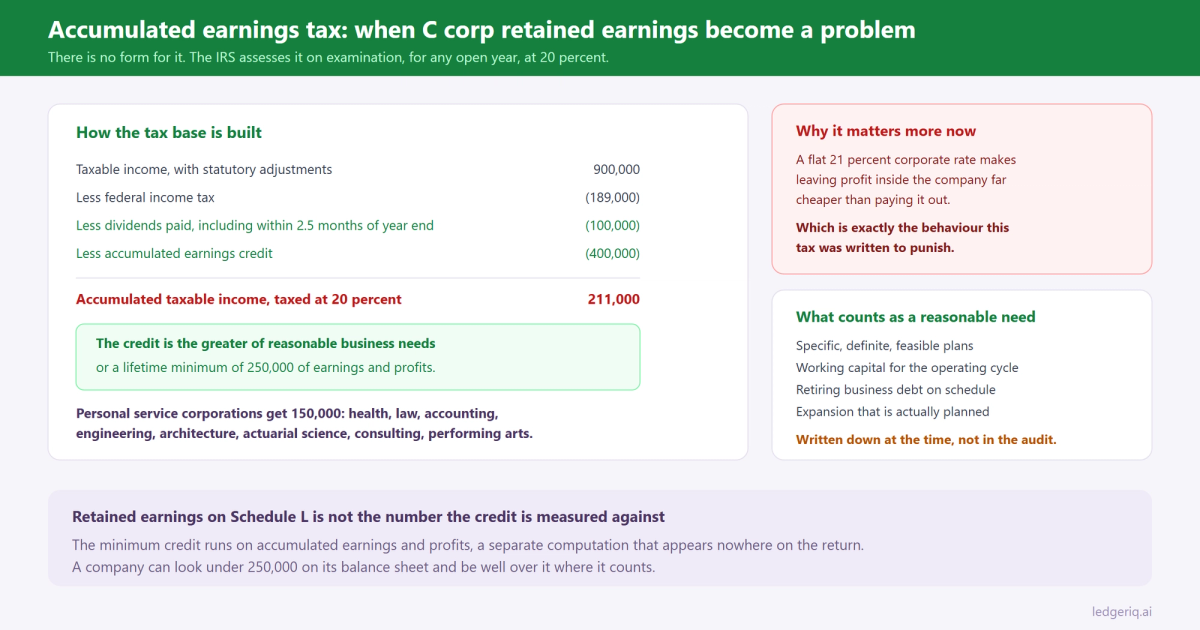


The accumulated earnings tax has no form. There is no box on Form 1120 to tick, no schedule to attach, no line where you compute it.
That is precisely what makes it dangerous. A corporation never self-assesses it, so nobody at the firm is ever prompted to think about it, and it arrives the only way it can: from an examiner, for an open year, at 20 percent of whatever the corporation kept that it should have paid out.
It was a fairly sleepy provision for a long time. The flat 21 percent corporate rate woke it up.
What it taxes
The accumulated earnings tax applies to a corporation formed or used to avoid income tax at the shareholder level by accumulating earnings instead of distributing them.
Read that carefully, because the trigger is purpose. The tax is not aimed at profitable corporations. It is aimed at corporations that keep profit inside the company so the owners never receive a dividend and never pay the second layer of tax.
The code makes that purpose easy to establish. If earnings accumulate beyond the reasonable needs of the business, that fact alone is treated as determinative of the forbidden purpose unless the corporation proves otherwise. The burden sits with the company, and the only proof that works is evidence the needs were real.
S corporations are outside it entirely, since their income already flows through. It is a C corporation problem.
Why 21 percent changed the arithmetic
For decades the corporate and individual rates were close enough that parking profit in a corporation did not save much. Distribute it or keep it, the combined tax came out in the same neighbourhood.
A flat 21 percent corporate rate against a top individual rate well above that made retention genuinely attractive. Leave the profit in the company, pay 21 percent, and defer the shareholder tax indefinitely. For an owner who does not need the cash, that is a meaningful saving.
It is also, word for word, the behaviour this tax exists to punish. So the incentive to accumulate went up at the same moment the exposure did, and plenty of closely held C corporations drifted into it without a single deliberate decision.
How the tax base is built
The tax is 20 percent of accumulated taxable income, and that figure is built in steps.
Start with taxable income and apply the statutory adjustments. Subtract federal income tax. Subtract dividends paid, which includes dividends paid within two and a half months after year end, so there is a window after the books close to reduce the exposure. Then subtract the accumulated earnings credit.
The credit is where almost all the planning lives. It is the greater of two amounts. The first is the portion of the year's earnings retained for reasonable business needs. The second is a minimum credit that lets a corporation accumulate up to a lifetime total of 250,000 of earnings and profits without having to justify anything.
For personal service corporations the minimum is 150,000. That covers corporations whose principal function is services in health, law, engineering, architecture, accounting, actuarial science, performing arts or consulting. Which is to say, a substantial share of the professional practices that end up as your clients.
Retained earnings is not the number that counts
This is the error that makes firms think a client is safe when they are not.
The minimum credit is measured against accumulated earnings and profits, not against retained earnings on Schedule L. Earnings and profits is a separate computation. It appears nowhere on the return, it is computed under different rules, and it drifts away from book retained earnings over the life of a company.
So a company can show retained earnings comfortably under 250,000 on its balance sheet and be well over it where the credit is actually measured. We covered why those two figures diverge in the Schedule M-2 on an 1120 article. The practical point here is that glancing at Schedule L line 25 tells you very little about accumulated earnings tax exposure.
What counts as a reasonable need
The regulations want needs that are specific, definite and feasible. Vague intentions do not count. "We may expand someday" is not a plan.
The needs that hold up are the ordinary ones, documented properly. Working capital for the business's operating cycle, which courts have long measured by reference to how long cash is tied up in inventory and receivables. Retirement of business debt on a real schedule. Expansion or replacement of plant and equipment that is actually planned, with a rough cost and timing. Reserves for genuine contingencies such as a pending lawsuit.
What undermines the defence is the pattern that shows up everywhere else in closely held company taxation: loans to shareholders, investments unrelated to the business, a large portfolio of marketable securities, and a dividend history that consists of nothing at all.
A corporation holding 2 million in brokerage accounts while claiming it needs every dollar for working capital is making an argument that its own balance sheet contradicts.
The documentation is the defence
Because the corporation carries the burden, the defence is built at the time rather than in the audit.
Board minutes that record the plan and the reason for keeping the cash. A capital budget, even a simple one. A working capital analysis that shows the arithmetic. Notes when plans change, so that an expansion abandoned in year three does not look like a fiction invented in year five.
None of it is elaborate and none of it can be manufactured convincingly after the fact. An examiner who sees minutes written in the week before the audit reads them for exactly what they are.
And if the accumulation genuinely is not needed, the cleanest answer is a dividend. The two and a half month window after year end exists for precisely that decision.
Where Ledger IQ fits
Ledger IQ does not compute the accumulated earnings tax. There is nothing to compute on the return, and earnings and profits requires information a trial balance does not hold.
What it does is keep the corporate picture honest year after year, which is what an examiner reconstructs first. Dividends map to their own named return line rather than hiding in an expense account, so the corporation's distribution history is visible in the workpaper instead of being a figure somebody has to dig out of the general ledger. A client that has declared nothing in eight years shows that plainly.
Net income per books is derived on the Working Trial Balance rather than retyped, and the equity section ties to Schedule L, so the retained earnings rollforward is a documented walk rather than a balance that simply appears. Year over year rollforward puts last year's balances beside this year's, which is how a steadily climbing cash and investment position gets noticed as a trend rather than as a single unremarkable number.
That is the raw material for the conversation that matters: whether this client is keeping profit for a reason, and whether that reason is written down.
Ledger IQ supports Forms 1065, 1120S and 1120, with exports for Drake, Lacerte and UltraTax CS. It is free during early access, so you can try it at portal.ledgeriq.ai on a live client without a credit card.